
Money in speculative fiction. Essay. 1200 words, 6-minute read.
Penny for Your Thoughts
By Ray Tabler
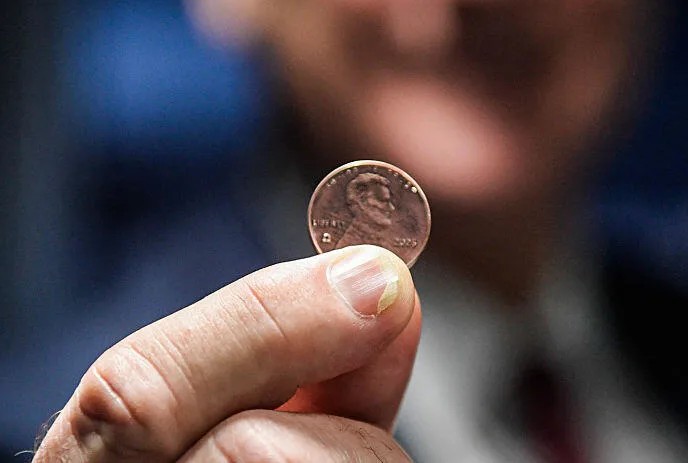
The looming demise of the penny from US currency threw a switch in my chaotic mind, shunting my thoughts to rumble down an unanticipated track. At a coffee shop, the change back from a cup of tea dropping into my hand was a mix of silver and tarnished copper. In the very near future, our coinage will be monochromatic, a uniform silver. Desirable or not, it will be a change (in change 😉). Writers in the future can use that visual difference as a fixed point in time, for various purposes. And, realize it or not, change is the essential ingredient in science fiction.
For a long time, the value our money was tied to the available supply of precious metals, usually gold or silver. That got to be inconvenient for bureaucrats, who never seem to have enough money to do what they want. Then, it dawned on them that since they printed dollars, they could print as many dollars as they wish. And this is still the case. There’s an internet meme which states the amount of gold which would buy an average home in the 1920s is the same amount of gold which would buy an average home today. I never verified this claim, but would not be surprised if it’s true. You just need a wheelbarrow to haul the cash for that home these days. Or perhaps a U-Haul.
This is called inflation, and it causes headaches for writers of science fiction and fantasy, alike. There are numerous sources online and in reference books to determine how many coins (gold, silver, copper, etc.…) buy various goods and services cost in different historical settings. That works well for historical fiction, and can probably be transferred directly to the typical medieval setting of most fantasy tales. Metal coins are the default option. Coins are small, easily carried, and can be melted down for restamping due to a change in monarchial management.
A fortuitous aspect of the fantasy genre is the ability to make up your own rules. A somewhat hazardous procedure if done poorly. But bordering on magical when done right. Some fantasy economies operate on fantastical currencies. Enchanted gems or crystals, mana (See Larry Niven’s fantasy), shells, beads, (specific) bones, teeth, or feathers are a few examples. And, of course, the devil deals in souls. Maybe your characters will as well.
As a practical matter, you want your currency to be scarce (preserving value) and nonperishable. Gold and silver fit that bill. Some of the above-mentioned items do, and some don’t. Which the clever author can profit from. Imagine a coinage that slowly, or rapidly, fades in value. That’s one way to drive plot and create conflict. Maybe the gold in your main character’s coffers spontaneously turns to lead at a random rate. Creates an incentive to go out adventuring for more on a regular basis.
Inspiration for fictional currencies can often be found in historical examples. Amber is scarce enough to be used for money. Away from the sea shore, the same with salt (the origin of the English word salary). Silk and spices common in the Orient financed operation of the silk road to Europe from the Roman era forward. There was an entire industry in the medieval Levant which unraveled thick silken fabric back into threads, so they could be rewoven into filmy, diaphanous silks. Which rich Europeans would pay through the nose for, in more ways than one. The demand for spices drove the European age of discovery, transforming the entire globe. All high-grade grist for the fantasy fiction mill.
Science fiction usually deals with the future. Unless time travel is involved. Then you still have to figure out the price of eggs in whichever past year you’re traveling to. See above. As pointed out, inflation will likely be with us for a while. So, a lot of writers throw in passing references to $50 and $100 hamburgers, for shock value. I used to laugh at that. But, have you priced a Big Mac lately?
To avoid the math of compound inflation over decades or centuries, the “credit” is a handy alternative to a named currency. It’s amorphous and applicable to diverse settings. A future hamburger (soyburger?) might cost 5 credits or 50, or 500, as determined by the writer. Be advised, though. The implication is that credits are not really tied to anything of real value. That means credits are issued by some (AI-enhanced?) authority, bestowing upon said overlords ominous control over everyone. But we’re already used to that type of funny money. So, it’s not really that big a leap. And, at least unprecedented central of finances provides the opportunity for drama a writer can employ. Say, a corrupt future government uses this power to debank troublesome people… Wait a minute. 🙄 That’s the trouble with science fiction. The fiction part keeps withering away.
A famous example of a science fiction currency is the spice from the Dune novels. This powder permits travel between the stars, a drug-fueled wormhole which only mutants can open. The spice also allows others to think as fast as a computer, and special people can see the future with it. Spice drives the interstellar economy, and is only available, with a lot of risk and effort, from one planet. The spice is an obvious metaphor for oil in the modern world. Although, I’m not a scholar of frank Herbert, so I don’t know if he intended it to be.
Outside of The Ferengi obsession with gold-pressed latinum, the Star Trek universe appears to be a post-scarcity society. This situation is supposedly a result of replicator technology, which supplies as much of whatever you want, for merely the energy cost of running the replicator and the urge to order up earl grey, hot! Perhaps I’m just a 21st-century stick-in-the-mud, who can’t wrap my head around new-fangled financial systems. But I’m not sure how such an economy would actually work, with actual humans. However, that’s the beauty of science fiction. The writer doesn’t have to explain everything, just enough to allow the reader/viewer to slide past such details and enjoy the story.
That said, post-scarcity societies assume all needs, basic and otherwise, are met by abundant production, readily available to all. Fair enough. It could happen if we advance technologically as fast as we have the past 200 years. Sure, people will still impose some kind of pecking order, even without money. In science fiction stories of this type the system usually runs on some kind of voluntary informal “tip” currency, or social credit score. (Where have I heard that phrase before?)
Personally, I’m skeptical. Still, I don’t know everything. Maybe post-scarcity would work well. When the United States began, the smart money expected our experiment in self-government bereft of a monarch to result in societal collapse and pathetic anarchy within a generation. Yet, the USA is still a going concern, despite our persistent efforts to make the whole thing crash and burn for the last 250 years. So, I suppose anything is possible.
Money makes the world go round, and the galaxy and realms too. The coins can be gold and silver, or credits and social tips, or crystals and captive souls. It all depends on how convincing and captivating the author can be when spinning the tale.
END.
Shameless Self-Promotion Section:
Check out my novels at Histria Books https://histriabooks.com/product-tag/ray-tabler/ and on Amazon https://www.amazon.com/stores/Ray-Tabler/author/B09H62RZB9
- The Diesel-Powered Starship (due for release in September 2025) https://histriabooks.com/product/the-diesel-powered-starship/
- A Grand Imperial War (Book 1 of the Grand Imperial series) https://histriabooks.com/product/a-grand-imperial-war-grand-imperial-series-book-1/
- A Grand Imperial Heir (Sequel to A Grand Imperial War) https://histriabooks.com/product/a-grand-imperial-heir-grand-imperial-series-book-2/
- Fool’s Paradise https://histriabooks.com/product/fools-paradise/
And visit my website https://raytabler.com/ for Science Fiction You Can Enjoy!