
Staring Into the Abyss. Essay. 1100 words, 6-minute read.

Neurotic Physicists
By Ray Tabler.
Do you know any physicists? I know a couple. They both seem like stable individuals. But then, they’re applied physicists, employed in industry, working on practical problems, required to produce results. I strongly suspect that theoretical physicists are a different breed of cat.
There’s a scene in the movie Oppenheimer. The title character describes the universe as consisting only of “…Forces of attraction strong enough to convince us matter is solid, to stop my body passing through yours….” Believe it or not, Oppenheimer was romancing a lady with that line. It worked. Oppy was a smooth operator.
Physics, as a discipline, is a spectrum. At one end are practical, necessary, everyday tasks. Some are relatively simple and straight forward. Newtonian mechanics predict stopping distances for automobiles, and the performance of sound-dampening materials. There’s a sort of middle ground, like safe operation of a nuclear power plant. Even Einstein’s relativity has practical, real-world applications. GPS satellites in high orbit travel fast enough, relative to us, that time passes a tiny bit slower for them. Those extra microseconds have to be accounted for when our phones are telling us to turn left at the next intersection.
Then, there is the far, theoretical end of physics, the end which might cause a person to question reality as we perceive it.
It will come as a surprise to some that matter, even solid matter like you and me, is mostly empty space. If an atom were the size of a sports stadium, the nucleus would be an orange at mid-field, and the electrons would be tiny specks zipping around in the cheap seats. But this planetary analogy model is more than 100 years old, and not exactly accurate. It implies that protons, neutrons, and electrons are incredibly small, but solid objects. Which they are not.
Physicists are, in large part, driven by curiosity. Every time they drill down to the next layer of reality, they find another one below that. What are neutrons, protons, and electrons made of? Even smaller particles. Quarks, leptons, gluons, and other subatomic critters in a zoo within every atom of our body, the table in front of you, and the galaxy on the far side of the universe.
No one has ever seen any of these Lego bricks from which our universe is built. They are way too small for light to image them, as we normally define “seeing.” They are too small even for electron microscopes to snap a photo of. Physicists smash particles together at breakneck relativistic speeds in cyclotrons and supercolliders with destructive glee. The wreckage from those collisions is examined by sensitive instruments. Then, statistical analyses of the readings are sifted through to figure out what it all means. The above all amounts to a trillion-piece jigsaw puzzle scientists are still trying to assemble.
Richard Feymann was the rarest type of genius, one who clearly explained the most complex concept to almost anyone. Here’s a YouTube video of a lecture, in which he lays out what data indicates is the true underlying nature of reality. It’s a bit mind-bending.
https://www.youtube.com/watch?v=fltB4ndnggk
Smart people in general, and physicists in particular, have the reputation for being odd, eccentric… Okay, let’s just say it, nuts. Most of that comes from focusing on problems and questions so intently, that all other concerns, relationships, time management, personal hygiene, suffer some neglect. As the saying goes, a PhD means knowing more and more about less and less. Compounding that issue for physicists is the undeniable fact that what they see, what all of us see, is an illusion.
Everyday items, including people, are not solid. They consist of various particles clumped in different patterns. The only difference between the table in front of them and a ham sandwich (or a big pile of ham sandwiches if you want to keep the mass the same) is the arrangement of protons, neutrons, and electrons. Further, the protons, neutrons, and electrons are made up of smaller particles. What do those even smaller bits hide within them? It calls to mind Augustus De Morgan poem Siphonaptera, https://en.wikipedia.org/wiki/Siphonaptera_(poem)
“…Great fleas have little fleas upon their backs to bite ’em,
And little fleas have lesser fleas, and so ad infinitum…”
The physicists cannot see this finer and finer structure to reality. They can only infer, glimpse it, via mathematics. An apt metaphor is from the Matrix movies. The main character perceives the computer simulation he and all the other characters inhabit as myriad lines of computer code running through the surroundings. If we are to believe the math, this is what the universe truly is, beneath the macroscopic illusion our minds drape it in.
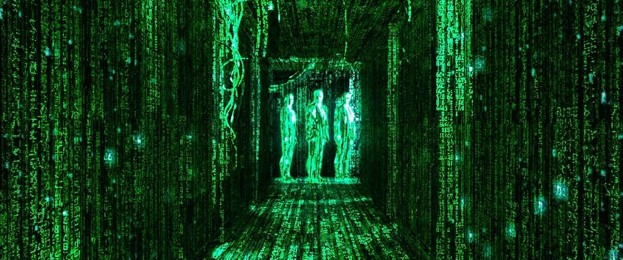
Is it any wonder that theoretical physicists often seem a bit weird? Unlike The Matrix’s Neo/Mr. Anderson, they can’t see the deeper reality. But they know it’s there. The data and the math prove it.
Some cope with this knowledge better than others. Richard Feynmann seemed to have been a fairly stable individual. Oppenheimer appears to have struggled. Of course, almost all I know of either man comes from a couple of movies. Feynmann was played by Matthew Broderick, and Cillian Murphy played Opperman. I cannot see Broderick without also seeing the lovable rogue Ferris Bueller, and Murphy invokes his brooding, intense characters from Peaky Blinders and Inception. Bleed over from one role to the next is unavoidable.
Piled on top of the foundational nature of the universe physicists must navigate, is a profound, and sometimes bottomless, source of angst. Physicists midwifed at the birth of nuclear weapons. Talk about your problem child. Not to say that it wasn’t necessary at the time. But, up until 1945, physics was a pure and pristine pursuit of knowledge for the good of all mankind. Then they took a bite of the apple, and ingested the knowledge of good and evil. Or, as Oppenheimer put it, “Now I am become death, the destroyer of worlds.”
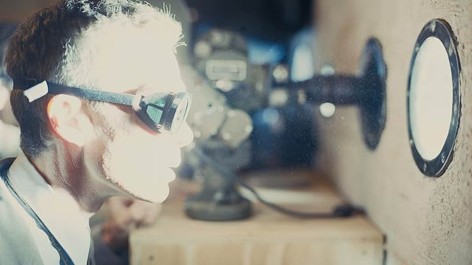
Ironically, many physicists chose physics as a profession, a calling, to escape the messy uncertainty of the conventional world views. Data and logic would replace tradition and religion. Or, so was the reasoning. And yet, the universe becomes stranger and more enigmatic the deeper it is probed. Physics cannot escape metaphysics. That’s enough to send anyone around the bend.

Pity the poor physicists. They’ve got a lot on their minds.
END.
Shameless Self-Promotion Section:
Check out my novels at Histria Books https://histriabooks.com/product-tag/ray-tabler/ and on Amazon https://www.amazon.com/stores/Ray-Tabler/author/B09H62RZB9
- The Diesel-Powered Starship (due for release in September 2025) https://histriabooks.com/product/the-diesel-powered-starship/
- A Grand Imperial War (Book 1 of the Grand Imperial series) https://histriabooks.com/product/a-grand-imperial-war-grand-imperial-series-book-1/
- A Grand Imperial Heir (Sequel to A Grand Imperial War) https://histriabooks.com/product/a-grand-imperial-heir-grand-imperial-series-book-2/
- Fool’s Paradise https://histriabooks.com/product/fools-paradise/
And visit my website https://raytabler.com/ for Science Fiction You Can Enjoy!