
Sci-Fi signposts. Essay. 1000 words, 5-minute read.
Star Trek and Recursive Prognostication
By Ray Tabler
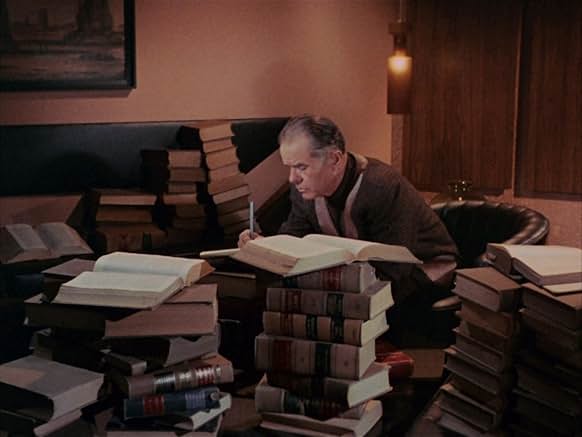
There’s an episode of the original Star Trek TV show, titled Court Martial, wherein captain Kirk is on trial for dereliction of duty leading to murder, specifically causing the death of another Star Fleet officer. Court Martial is an entertaining episode, and I won’t spoil the ending for those who haven’t seen it. Watching as a child, what stuck with me from this one was a character named Samuel T. Cogley, Kirk’s crusty, crotchety, luddite of a defense lawyer.
Cogley’s eccentricity caused others in Star Fleet to roll their eyes at his archaic attitudes, and his insistence on dragging a library of physical, printed books around with him. Cogley, you see, didn’t used computers. He maintained that The Law (you could hear the reverent capitalization in his voice) lived not in soulless machines, but in the minds of people. You had to read the law enshrined in books, then ponder and reason your way through to justice within your own brain. Cogley didn’t trust ephemeral zeros and ones, subject to rapid and sly revision in a memory bank.
In 1967 the bulk of human knowledge did indeed reside on the printed page. (As opposed to before the invention of printing, when it existed hand-carved into stone or inked upon parchment and papyrus.) The smallest computers were the size of washing machines. Even the first pocket calculators were years away. The very idea of near total reliance on computers really did belong in a sci-fi show. Half a century later (in the words of Edna Mode, in The Incredibles) “…yet, here we are.”
We are wrestling with Cogley’s admonitions right now. To be sure, legal briefs generated by LLM AIs are not exactly up to snuff at the moment, riddled with errors and nonexistent precedent case law. But they’ll get better as the software improves. Then we will face the conundrum Cogley warned of. Does the law serve man, or does man serve the law? Do machines serve man, or does man serve the machine? Migraine-inducing questions.
Star Trek is the premiere example of fiction foretelling the future. Movie prop cellphones and desktop computers hung from Mr. Spock’s belt and cluttered Bones McCoy’s office table. Recently, NASA has funded research into a theoretically valid warp drive, and physicists have built an, admittedly ridiculously wimpy, tractor beam. This fosters the belief that the future really can be predicted, at least the scientific parts.
The truth is more complicated than that. How much of progress is inevitable, and how much is the result of self-fulfilling prophesies? There is no doubt that Star Trek’s communicators, warp drives, and tractor beams inspired scientists and engineers in their research and development. What might the electronic devices of today have looked like if the prop designers of Star Trek, and other productions, made different design choices? What might our world look like today if the writers had been visited by different muses?
Star Trek, and every article of science fiction, are heavily influenced by the times in which they are written. While simultaneously attempting point the way to escape those times to another world. The tension of that struggle is discernible. A number of Star Trek original series episodes deal with the simmering cold war between the Federation and the Klingon, and Romulan empires, echoing the real-world relationship between the West and the Soviet sphere. By Star Trek The Next Generation the Klingons had joined the Federation, reflecting the brief period when the world dared to hope Russia would play nice. Evidently, geopolitical prognostication is a heavier lift than technical forecasting. Not exactly a surprising result.
Science fiction is a sandbox, where creators can build sandcastles for inspection and evaluation. Of course, because people are the way they are, you have to spin an engaging tale for us to tour your sandcastle. If the tale is good enough, the castle can have some rough edges. Conversely, a truly imaginative and well-made castle will attract visitors even with a weak or hackneyed accompanying story. To be sure, it’s best to make both as good as you can.
But even the best castles and stories inherently limit our vision of what the future can be. People typically will adopt a concept of where humanity is headed from the pre-packaged options presented in printed and visual media, usually influenced by personal preferences and outlook. Optimists choose Star Trek’s hopeful vision. Pessimists internalize darker predictions like The Matrix, Bladerunner, or even Soylent Green. There’s probably an entire essay, maybe even a PhD dissertation, lurking in how prevailing public sentiment, by decade, guides the popularity of differing science fiction tales.
There’s always the temptation to proselytize for the way the author think things ought to be, as well. This is an urge which is harder to resist the more popular the work is. Gene Roddenberry openly advocated for his tolerant point of view via his productions and largely succeeded in by inspiring countless fans. Paul Verhoeven aimed to craft an anti-militaristic message with his film adaptation of Heinlein’s novel Starship Troopers. The backlash from Heinlein fans may have overwhelmed that intent, and certainly diluted Verhoeven’s message. Both efforts influence subsequent storytellers, providing a useful model or an example of what not to do. Your choice as to which is which.
Practically speaking, science fiction authors are usually just trying to make a living, or at least break even, in a tough market. So, it’s a bit cruel to pile more responsibility onto their plate. That said, in a very real sense the stories they tell, the worlds they build, steer and channel what we view of what our future can look like in a recursive feedback loop. With that cheerful insight in mind, you can go back to typing now. 😊
END.
References:
- Warp field Mechanics 101 – https://ntrs.nasa.gov/api/citations/20110015936/downloads/20110015936.pdf
- Functional Tractor Beam – https://www.livescience.com/space/space-exploration/tractor-beams-inspired-by-sci-fi-are-real-and-could-solve-the-looming-space-junk-problem
Shameless Self-Promotion Section:
Check out my novels at Histria Books https://histriabooks.com/product-tag/ray-tabler/ and on Amazon https://www.amazon.com/stores/Ray-Tabler/author/B09H62RZB9
- The Diesel-Powered Starship (due for release in September 2025) https://histriabooks.com/product/the-diesel-powered-starship/
- A Grand Imperial War (Book 1 of the Grand Imperial series) https://histriabooks.com/product/a-grand-imperial-war-grand-imperial-series-book-1/
- A Grand Imperial Heir (Sequel to A Grand Imperial War) https://histriabooks.com/product/a-grand-imperial-heir-grand-imperial-series-book-2/
- Fool’s Paradise https://histriabooks.com/product/fools-paradise/
And visit my website https://raytabler.com/ for Science Fiction You Can Enjoy!