
Essay. 1000 words, 5-minute read.
Novel Lengths of SciFi Greats
By Ray Tabler
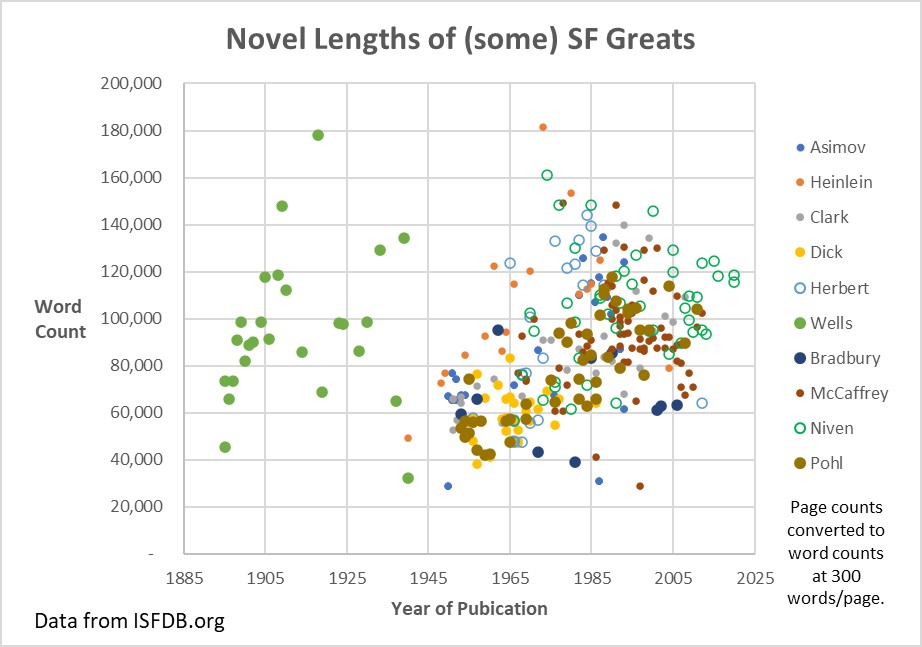
This essay is the latest in a series wherein I indulge my near obsession with the various aspects of novel lengths over the years. Two previous pieces looked at book lengths of “most read () and best-sellers (). This installment focuses on the lengths of novels written by 10 greats in the science fiction field. The aggregate result is graphed above.
Choosing the top 10 science fiction authors is always going to be a controversial undertaking. So, I wimped out and arbitrarily grabbed someone else’s opinion. I simply wanted a list to guide gathering the data. So, if you have beef, please take it up with the fine people at discoverscifi.com, https://discoverscifi.com/the-top-10-greatest-sci-fi-writers/). More names could certainly be added, and I’ll have more to say about that further down.
Hullabaloo thus successfully dodged, the list is:
1 Isaac Asimov
2 Robert Heinlein
3 Arthur C. Clarke
4 Philip K. Dick
5 Frank Herbert
6 H.G. Wells
7 Ray Bradbury
8 Anne McCaffrey
9 Larry Niven
10 Frederik Pohl
The aggregate graph, I will admit, resembles a Jackson Pollack painting, complicating interpretation. However, a couple of observations can be made. First, there is a lot of scatter in the data, even for a single author. Also, as noted in the previous 2 essays, novel lengths appear to follow a rhythmic pattern. From Edwardian verbosity around the turn of the 19th/20th centuries, to a mid (20th) century austere minimum, to another peak of long-windedness in the 1990s, book lengths resemble a roller-coaster ride. It’s hard to tell, but novel word counts may be headed down hill again. At least according to this data.
Why the variability? I can think of a few reasons. The early 20th century was an era with a slower pace of life, and people had more time to read longer books. Modernity speeded things up. The world wars altered reader appetites, dictating shorter stories, packaged in fewer pages. The post-war, affluence leveraged more immersive, richer tales that required longer books to tell adequately. Now, the internet and social media have atrophied out attention spans, and are driving book lengths down again.
Maybe. Or it could all have to do with the price of paper and ink. Or the rise and decline of the science fiction magazine culture which reached its peak in the 1950s and 1960s. I don’t really know, and I suspect multiple factors interact in a subtle dance. The above is all wild (probably ill-informed) speculation on my part. Here’s the data. Let the vigorous debate begin. It’ll probably be informative and good for the genre to engage in. It’ll certainly be entertaining to watch.
When I have the time, I plan to go back and add more early 20th century authors (say Edgar Rice Burroughs and AE Van Vogt). It’s bad practice to rely on only one source of data. And, august as HG Wells is, more writers would bridge the gap between his time and the post-world-war II science fiction era. Perhaps some surprises will present themselves. In addition, I am curious if the fantasy genre follows the same trends, or plows its own word count course. Expect more essays in this series.
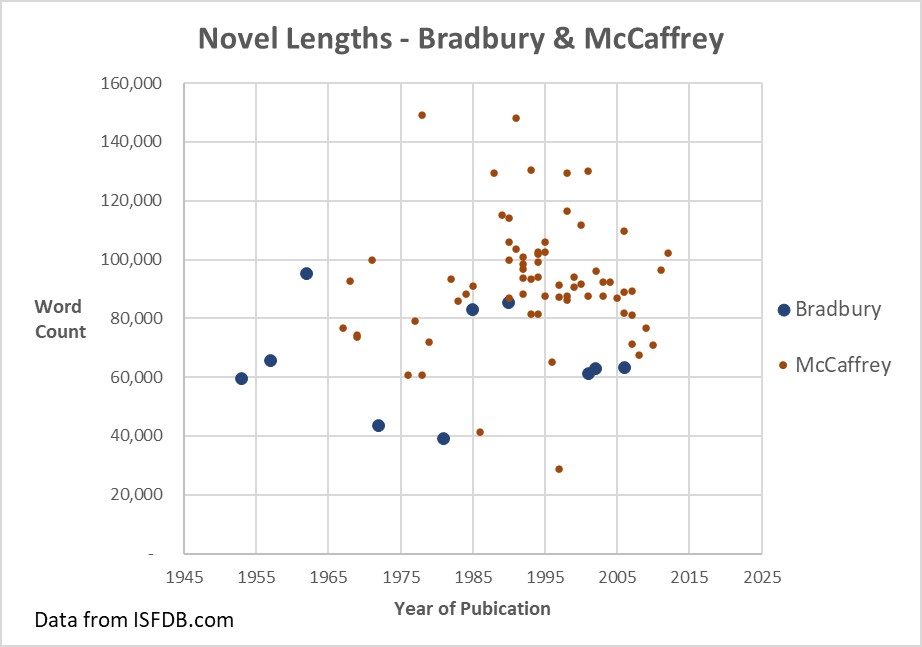
Recognizing that the aggregate graph is crowded and hard to read for individual authors, I’ve replotted the data below is a series of 5 graphs, 2 authors each. Interesting observations pop out.
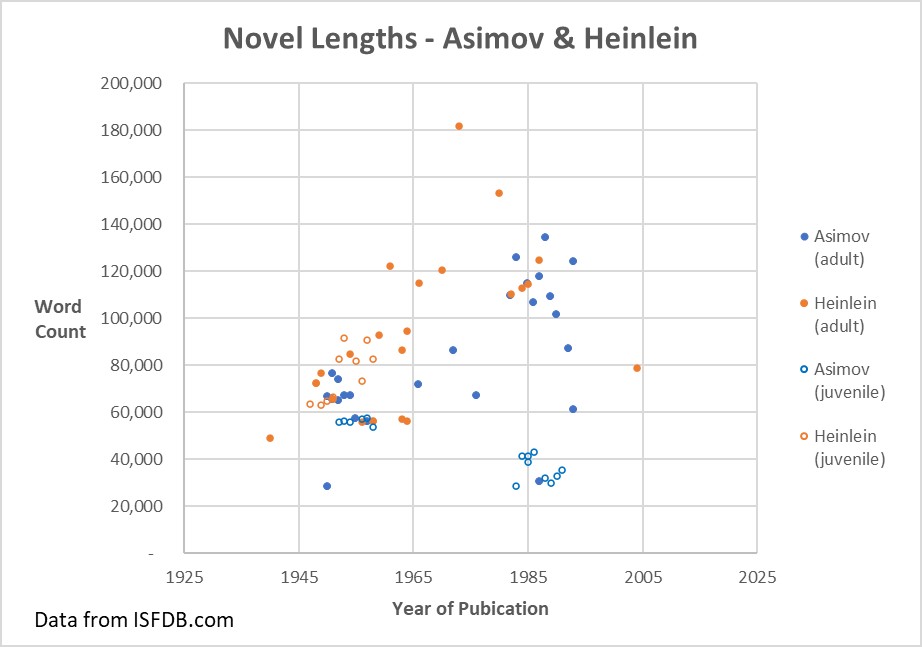
The aggregate graph includes only adult novels. Both Asimov and Heinlein, however, are famous for a number of juvenile novels. Those are displayed as open (unfilled) data points, and are uniformly shorter than average in word count. I don’t have the data to back this up, but am under the impression that young adult novels these days are longer in comparison.
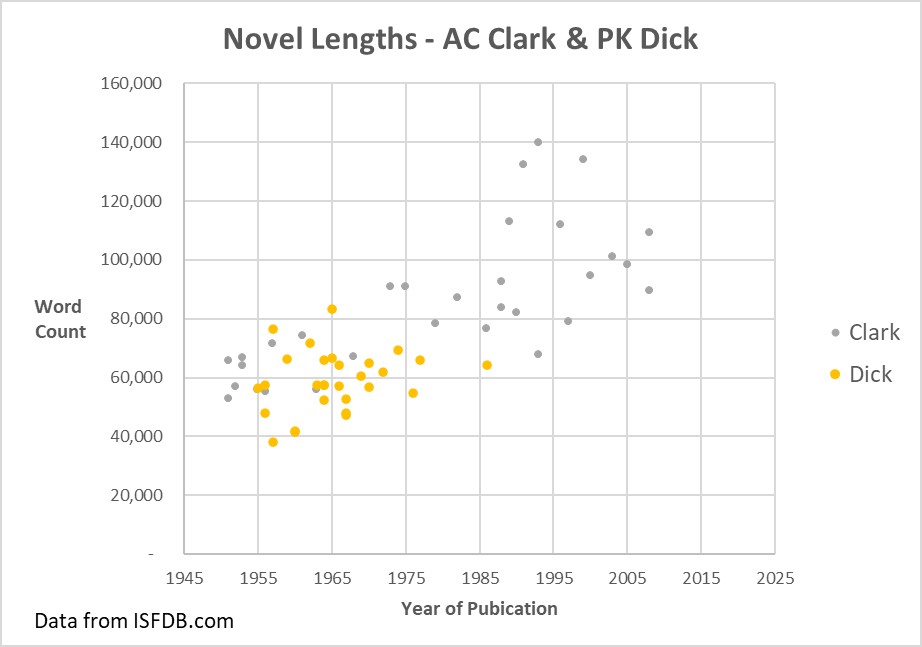
It’s interesting to compare the lengths of Authur C Clark’s and Philip K Dick’s novels. I was mildly surprised at the number pf PK Dick novels, having only been familiar with his later work. Those books dominate his canon. Both Clark and Dick are somewhat overrepresented in dramatic adaptations of their novels. PK Dick, in particular. All Dick novels are on the shorter side, and I wonder if that suits them to converting them to screenplays. If Philip K Dick had lived longer, would his books have trended longer? We’ll never know.
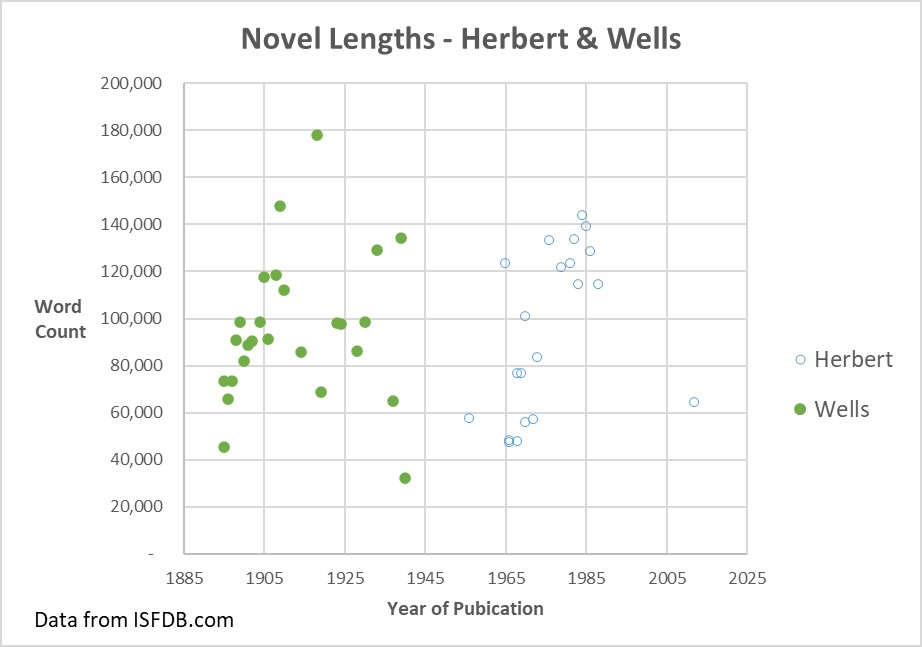
HG Wells and Frank Herbert hail from radically different eras, but their novel lengths spread over much the same spans.
It came as a surprise to me how few actual novels Ray Bradbury wrote, considering the influence he exerted over the genre. There’s no doubt the man was prolific. But much of his work took the form of short fiction and screenplays. Which likely influenced how long his novels were. That’s simply the way his muse chose to speak to him. In contrast, Anne McCaffrey’s muse must’ve had a lot to say. She published an impressive 69 novels, and they tended to north of 80,000 words.
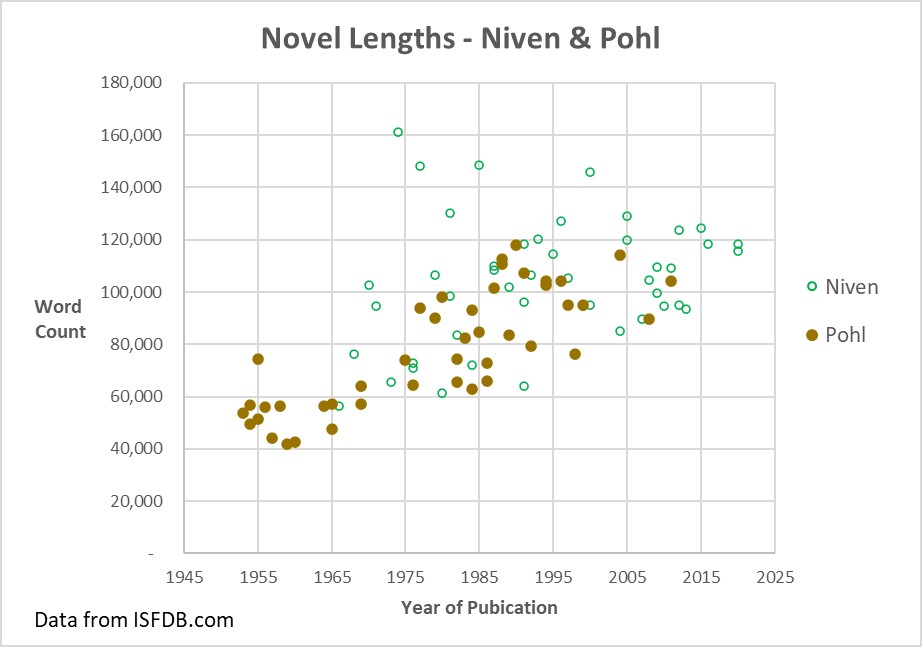
The writing careers of Larry Niven and Frederik Pohl overlap to a large extent. Both rode the upward drift in novel lengths, leveling out once the trend seems to start down again after the turn of the 20th/21st century.
As mentioned, more data is needed to bridge the gap between the early 20th century and the post-world-war II time frame. It is my ambition to undertake a similar investigation of the fantasy genre. I am curious if earlier fantasy novels were as lengthy as they are these days. Do mystery, romance, and thriller novels lengths dance to the same rhythm over the decades? Perhaps some day I will find out.
Details, details… The data was gathered from the isfdb.org website, which is an invaluable resource. Page lengths of first-published, non-magazine, editions of each book were converted to word counts using a factor of 300 words per page. The data is available below for those wishing to analyze further.
END.
Data is available for inspection and download at: https://www.datawrapper.de/_/hAx0U/
Shameless Self-Promotion Section:
Check out my novels at Histria Books https://histriabooks.com/product-tag/ray-tabler/ and on Amazon https://www.amazon.com/stores/Ray-Tabler/author/B09H62RZB9
- The Diesel-Powered Starship (due for release in September 2025) https://histriabooks.com/product/the-diesel-powered-starship/
- A Grand Imperial War (Book 1 of the Grand Imperial series) https://histriabooks.com/product/a-grand-imperial-war-grand-imperial-series-book-1/
- A Grand Imperial Heir (Sequel to A Grand Imperial War) https://histriabooks.com/product/a-grand-imperial-heir-grand-imperial-series-book-2/
- Fool’s Paradise https://histriabooks.com/product/fools-paradise/
And visit my website https://raytabler.com/ for Science Fiction You Can Enjoy!