
“Where the f(#k is my jetpack?” Essay. 1100 words, 6-minute read.

Jetpack Dreams
By Ray Tabler
“🎶Where the f(#k is my jetpack?🎶” – Tim Wilson, singer/songwriter, troublemaker. https://www.youtube.com/watch?v=brr4RNGlts0
There is no more iconic sci-fi icon than the jet pack. Followed closely by the flying car, which is simply a jetpack with a windshield and a bucket seat. The jetpack taps into the heady promise of THE FUTURE. It evokes the ultimate freedom, personal air travel, without the sordid, pedestrian bother of the security checkpoint and waiting for your zone to be called by the gate agent.
Sadly, jetpacks are not common for morning commutes yet, despite some promising developments in the area. Some, poor, benighted individuals rationalize that is for the best. They point out the probable airborne traffic snarls, and skyrocketing aerial accident rate likely to occur. It reminds me of what Louis Armstrong, famous jazz musician, said when asked about his fear of flying. “Say you in a car or a boat, and the motor quits. Well, there you is. Say you in an airplane, and the motor quits. Well, there you ain’t!”
Jetpacks, as a technology, face several tall hurdles to clear before they’ll be in wide-spread use by the general public. Working designs have been available for decades. As early as the 1960s jetpacks that will fly you from here to there have been thrilling crowds at events, and fascinating viewers in TV shows and movies. The earlier models were fueled by hydrogen peroxide, strictly speaking a rocketpack not a jetpack. The recent offerings utilize miniaturized jet engines, attached to the pilot’s arms for steering.
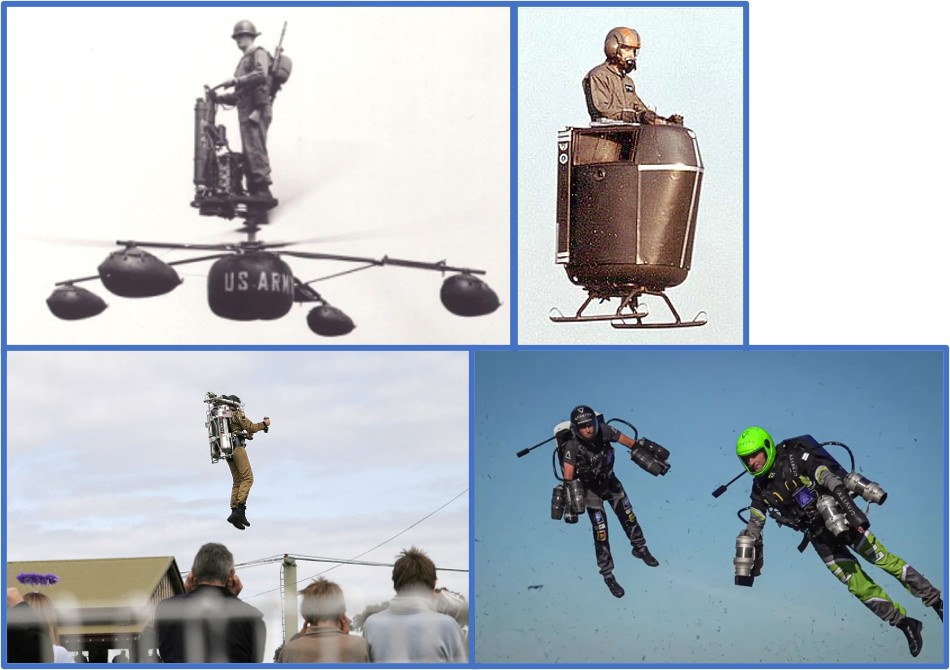
Both currently fielded rocketpacks and jetpacks share a limitation, though. Neither can carry enough fuel to stay aloft for very long. The best jetpacks available today boast flight times of less than 10 minutes. That’s way too short for most purposes, even at jetpack speeds. To say nothing of the bother from commuters plummeting from the sky when the tank runs dry. Also, most people can barely keep a surface vehicle between the ditches and out of somebody else’s grill. Insurance actuaries across the globe would go apoplectic at the thought of those same drivers strapping on a jet pack, adding another degree of freedom to their movements, at ballistic speeds.
So, you see, it’s very unreasonable to pine for a personal jetpack, readily available and affordable to the average Joe, or Jane. Which is precisely why we should continue to do precisely that. We want that gosh-darned jetpack. And we want it right now!
Let me explain. This is how progress, real progress, happens. People perceive a need, and give voice to that desire. Clever innovators pay attention to demands, and figure out how to meet them. The profit motive works best as motivation. The more difficult the problems involved, generally, the longer it takes, but the greater the eventual reward for success.
Simple, reliable, affordable jetpacks have proven to be a thornier problem than originally anticipated. But the demand remains. So, researchers, tinkerers, entrepreneurs continue to chip away at the challenge.
The eventual solution may not resemble the original concept of a backpack rocket or jet. Newton’s 3rd law and the rocket equation demand reaction mass to toss out the back door in order to move forward. At this point in time, we just don’t have any fuel with the energy density we want. Maybe an electrically-powered turbofan would work. But there is no battery around right now which would be both powerful and light enough to get off the ground. Nuclear power? Antigravity? No, I have no idea how either of those would work. But we will never have a clue if we don’t look into them.
As an example, drone technology is a concept which wandered the wilderness for a long time before seeming to blossom in the past few years. Unmanned space probes and ICBMs required self-direction. As that capability was developed and refined, it was applied to tasks of lower stakes. The original researchers never dreamed drones would be used to map archeological sites, or deliver groceries. Of course, drones hunt down enemy soldiers and deliver explosives. But, we humans can and will turn anything into a weapon. Pandora’s box, like most myths, are about us, not the gods.
Writers of science fiction are particularly aware of the power of unreasonable expectations. The genre shakes minds loose from the ordinary, planting dangerous visions wrapped in gripping yarns. The Star Trek universe is a case in point. Gene Roddenberry didn’t know how to make communicators, desktop computers, tricorders, or warp drives actually work. He simply introduced the concepts. Shining, alluring concepts.
Within decades, most people had cellphones in their hands. Desktops, laptops, and tablets had revolutionized the workspace. Ultrasound, NMR, and CAT scans had saved countless lives. Would these devices have come about without the TV show? Probably, eventually. But Roddenberry cast a vision upon the world, a target to aim for. And, frankly, that’s half the battle.
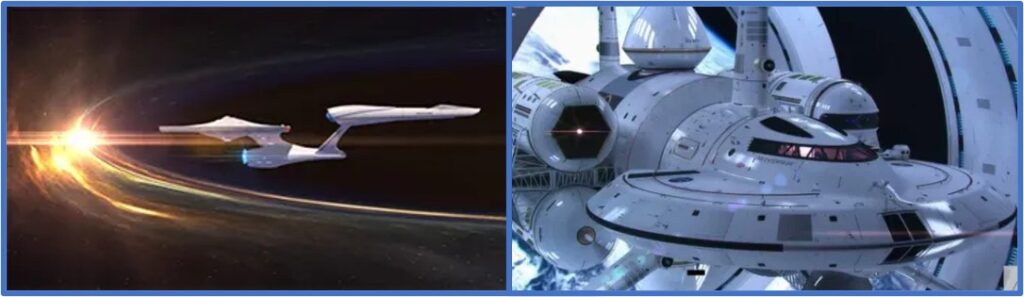
Another seed planted by Star Trek has barely begun to sprout. In the 1990s, a Mexican physicist, Miguel Alcubierre, was intrigued by the concept of the warp bubble hinted at by the show. He explored the math, and, to his surprise, discovered that a way to travel faster than light is at least theoretically possible. Granted, we don’t know how to power this device…yet. But, conventional thinking at the time would’ve dismissed the idea out of hand. (Did dismiss it actually.) Alcubierre followed the unreasonable impulse to explore a ridiculous idea, and (maybe) pried open a locked door to the stars for us.
Unreasonable demands and insatiable curiosity are the engines by which the human race has stumbled its way down from the trees, out onto the savannas, to the ends of the earth. It has been risky. Costly mistakes have been made, and will continue to be made. If we’d listened to the experts, we’d simply line up to ride the bus to work, never suspecting a better way might be possible. If we’d listened to the experts, we’d still be whipping the horses to pull wagons and shoveling manure out of the muddy streets.
Asking the wrong questions, the ones that rock the boat, poses a risk. And experts are as risk averse as the rest of us. Only a few are cursed with the foolhardy courage to wander right up to the edge, and peer over into the abyss. Experts are useful. But they are limited by their expertise. They don’t know what they don’t know.
And neither do we. We never will, until we chase unreasonable dreams into impossible territory. Because the possible is indistinguishable from the impossible, without going there and finding out. So, where the f(#k is my jetpack?
END.
Shameless Self-Promotion Section:
Check out my novels at Histria Books https://histriabooks.com/product-tag/ray-tabler/ and on Amazon https://www.amazon.com/stores/Ray-Tabler/author/B09H62RZB9
- The Diesel-Powered Starship (due for release in September 2025) https://histriabooks.com/product/the-diesel-powered-starship/
- A Grand Imperial War (Book 1 of the Grand Imperial series) https://histriabooks.com/product/a-grand-imperial-war-grand-imperial-series-book-1/
- A Grand Imperial Heir (Sequel to A Grand Imperial War) https://histriabooks.com/product/a-grand-imperial-heir-grand-imperial-series-book-2/
- Fool’s Paradise https://histriabooks.com/product/fools-paradise/
And visit my website https://raytabler.com/ for Science Fiction You Can Enjoy!