
Orbital reads. Essay. 1100 words, 6-minute read.
Books in Space
By Ray Tabler.
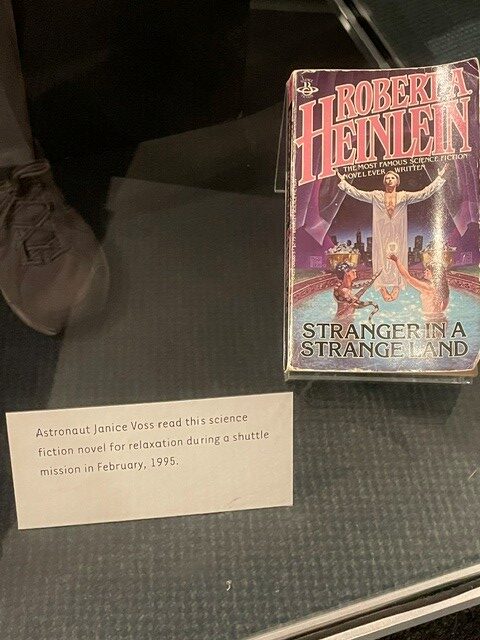
Recently, I visited an Air and Space Museum. Tucked away in one of the display cases was the unexpected gem pictured above, a copy of Robert Heinlein’s Stranger in a Strange Land read aboard a space shuttle mission in 1995. That got me curious as to what books have been to space. There have been a few. And by a few, I mean many.
First off, boosting mass into orbit is, or at least has been, an expensive business. I’ve read that Mr. Musk’s efforts are bringing those costs down at a record pace. But still, every gram counts. So, lofting a piece of dead tree with words printed on it into even low Earth orbit is probably not the best use of rocket fuel. Groups of properly-arranged electrons, in the form of an e-book is much more efficient. However, I don’t know when that transition occurred. If you do, please let us all know.
The first books in space of which I am aware were during the 1965 Gemini mission(s?). not sure if these were on the same launch or not. Frank Borman brought along Mark Twain’s Roughing It. Jim Lovell brought Drums Along the Mohawk, by Walter D. Edmonds. How much time for reading they had is unknown.
Frank Borman packed 2001: A Space Odessey for 1968’s Apollo 8. 1969 was a big year for books in space. Astronaut Eugene Cernan brought A Tale of Two Cities by Charles Dickens aboard Apollo 10. The same year, Apollo 11 carried a mini space library along. Buzz Aldrin brought H.G. Wells’s War of the Worlds. Michael Collins packed both The Journals of Lewis and Clark and Robert Heinlien’s The Moon is a Harsh Mistress. Collins was apparently a voracious reader.
Then there are the many space Bibles. During the Apollo 8 mission, astronauts Frank Borman, Jim Lovell, and Bill Anders read the first ten verses of Genesis, the creation story, via a radio broadcast on Christmas Eve 1968. Reportedly, this was an extremely abridged edition of the holy book, consisting of only the 10 versus printed on index cards. But I think that still counts.
After Apollo 11 landed on the moon, Buzz Aldrin took part in a holy communion service while in the lunar lander. This was not broadcast due to a lawsuit over the Apollo 8 orbital Bible study. Fellow astronaut Neil Armstrong did not participate. (Different denominations?) No physical text was involved. Just including this occurrence for completeness. Apollo 12 planned to take “microform” (microfilm) Bibles in the lander, but an error caused them to be left in the orbiting command module. Close, but no cigar.
Apollo 13 (1970) and Apollo 14 (1971) carried more copies of the microform Bibles along. Apollo 13 famously ran into trouble, and didn’t make it all the way to the moon. Apollo 14 did land on the lunar surface, with their Bible. First book on another world. (I assume that the other books carried on Apollo 11 didn’t make it down to the lunar surface. Which would make sense, given every gram cost more fuel.) During the Apollo 15 mission, commander David Scott managed to bring a physical, printed copy of the Bible down to the surface. He intentionally left it on the lunar rover. In all likelihood it’s up there still.
Numerous other bibles and other religious texts have been carried into space by astronauts and cosmonauts. But, let’s move on.
Astronaut William Pogue brought The Time Machine by H.G. Wells onto Skylab 4 in 1973.
I have read that a small library of reading material was available on the Soviet (then Russian) space station, Mir. The first “permanent” space station, by the way (1986-2001). However, the internet is reluctant to reveal the catalog of this library to me. If you know, please share. NASA visitors to Mir brought contraband capitalist tracts aboard. Astronaut Michael Foale smuggled The Hitchhiker’s Guide to the Galaxy by Douglas Adams in 1997. A subversive work, if ever I saw one.
In addition to the copy of Stranger in a Strange Land astronaut Janice Voss enjoyed on the space shuttle in 1995 (pictured above), Robert Gibson took The Right Stuff by Tom Wolfe on the space shuttle in 1991. In 1994, Koichi Wakata brought Frank Herbert’s Dune. And Shannon Lucid packed a copy of The Invisible Man by H.G. Wells on the Space Shuttle in 1996.
The advent of the International Space Station (ISS, 2000 to present) has coincided with the internet, muddying the waters as to which books are “in space.” Since almost any literary work can be downloaded (uploaded?) directly to an e-reader or tablet aboard. No matter. We’ll forge ahead with notable examples.
These books are documented as having been enjoyed aboard the ISS. The Lord of the Rings by J.R.R. Tolkien; Clay Anderson, 2007. The Diary of Anne Frank; Daniel Tani, 2007. The Hitchhiker’s Guide to the Galaxy by Douglas Adams; Samantha Cristoforetti 2014. A Journey to the Center of the Earth by Jules Verne; Terry Virts 2015. The Martian by Andy Weir; Tim Peake 2016. The Martian is a tale of an astronaut surviving after a space disaster. Maybe Tim Peake was just following the Boy Scouts motto: Be Prepared.
I would be remiss if I didn’t mention the Story Time From Space Foundation (https://storytimefromspace.com/). Numerous videos are available online of people on the ISS reading children’s books and conducting demonstrations of microgravity conditions. This is aimed at younger readers, and promoting interest in STEM careers.
In addition to personal copies of books brought to the ISS, there is an official library up there, for “recreational/off-duty consumption.” The latest catalog I could find online is from 2008. (https://www.governmentattic.org/docs/ISS_Media_2008.pdf). Well over a hundred books, movies, TV shows, and musical albums fill the list. Notable examples include classics such as Tale of Two Cities, Around the World in 80 Days, and Origin of the Species, as well as more contemporary videos like When Harry Met Sally, Caddyshack, A Few Good Men, Gone With the Wind, Goldfinger, and Austin Powers: The Spy Who Shagged Me. Not surprisingly, science fiction and fantasy works are heavily represented: Harry Potter, The Matrix, Indiana Jones, Men in Black, Pirates of the Caribbean, Star Gate (original movie & SG-1), The Princess Bride, and Lord of the Rings. Back Issues of both Analog, and Asimov’s SF magazines are available. Authors David Weber, Harry Turtledove, Eric Flint, Piers Anthony, Lois McMaster Bujold, Robert Jordan, John Ringo, Catherine Asaro, Terry Brooks, Kim Stanley Robinson, and many more appear.
These days any book can be a space book, with the inconveniencing of a few electrons. But there is still a thrill for a writer if someone off world reads their work. No doubt the above listing of books in space is incomplete. Also, I’ve probably made a few (unintended) errors. Please correct them if you know better. Reading is fundamental, but the sky is no longer the limit for books.
END.
Shameless Self-Promotion Section:
Check out my published novels at:
nazcapress.com/product/smitty/NP/52/ (Smitty’s Guide to Interstellar Bartending, available now!)
https://histriabooks.com/product-tag/ray-tabler
amazon.com/stores/Ray-Tabler/author/B09H62RZB9
And visit my website https://raytabler.com/ for Science Fiction You Can Enjoy!