
The alienness debate. Essay. 1600 words, 8-minute read.
In Defense of Rubber Suits
By Ray Tabler
A perennial debate within science fiction concerns the alienness of aliens. Sentient species who evolve under other suns will probably not be very much like us. Environmental conditions on exoplanets are different, and will birth different beings. This is simply logical. Is it true? Probably, but we just don’t know with certainty. Humanity hasn’t encountered any aliens yet to put this theory to the test. As far as I know
In the complete absence of evidence, speculation runs wild. And unbridled speculation is the foundation of science fiction. Tempered by strict adherence to physical laws (as we currently understand them) or fueled by fabricated physics, the science fiction writer is free to conjure up entire alien species from fever dreams. In fact, the only constraint on fictional aliens is what the reader, or the viewer, is willing to accept. Not even that if you don’t care about sales.
Money talks. If a writer wants to make money from his writing, what will sell is of primary concern. And, frankly, rubber suits are the safest bet.
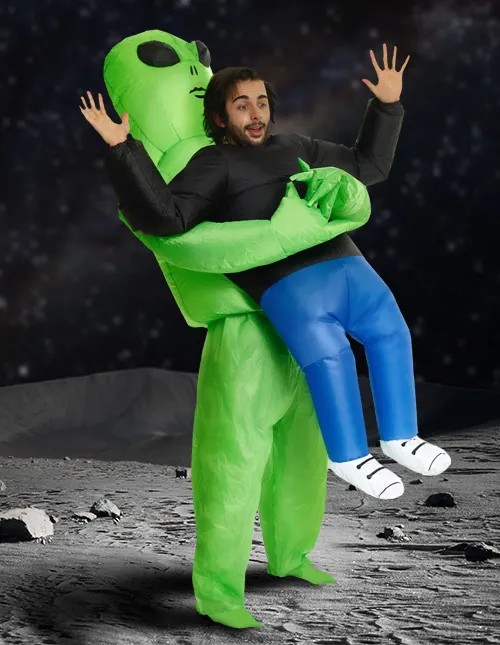
Rubber suit alien is a derogatory term for a fictional alien species which is really just a human in a cheap rubber suit disguise. It harks back to 1950s sci-fi movies where the creature from outer space was clearly a stuntman wearing a cheesy costume. Examples are Robot Monster (1953), Creature from the Black Lagoon (1954), The Thing from Another World (1951), and even Godzilla (1954). Limits of 1950s technology, and limits of motion picture budgets, created this situation. Audiences, cognizant of these constraints, didn’t seem to mind.
In fact, there’s a long tradition of simply casting humans as aliens. The 1930s Buck Rodgers and Flash Gordon serials had very human-looking aliens. The Martians of Edgar Rice Burroughs’s Barsoom novels were simply red-hued, egg laying humans. (Who could breed successfully with the hero of the books, John Carter, incidentally. Never mind killjoy questions about differing numbers of chromosomes and the like.) The Star Trek universe continues a humanoid-centric orientation by gluing some brow ridges or pointy ears onto the alien of the week, and calling it good. They could procreate with people too. Mr. Spock is a half-breed Vulcan/human mix. Although, to be fair, the later Deep Space 9 series retconned an explanation via an elder race who seeded the Milky Way with compatible DNA in the deep past. We’re all just distant cousins in the big, happy humanoid family.
Even so, vintage sci-fi did manage to come up with a handful of truly alien aliens now and then. The Blob (1958) was a movie about a giant extraterrestrial Jello mold, which consumed everything in its path. Day of the Triffids (1963) told of a terrifying invasive alien plant species. In The Monolith Monsters (1957), living rocks fall from the sky, grow tall and tippy when watered, and topple onto people and houses. The Horta, from the Star Trek original series episode Devil in the Dark (1967), haunt the dark tunnels of a mining colony. The Horta are initially another lumpy monster of the week, hunting human colonists. Turns out there’s only one Horta left, a mother trying to protect her hibernating eggs. Spoiler alert, Spock figures this out with a mind meld, and Kirk manages to reconcile the egg-smashing colonists with the Horta. Roll credits.
Notice anything? Truly alien aliens tend to be horrible, dangerous monsters, focused on eating, and or crushing the life out of us hapless humans. Now, drama needs bad guys, and it’s convenient to make bad guys easy to fear and hate by making them not human (unhuman?). The less human the better. That’s a handy dramatic technique. Notice that Star Trek’s Devil in the Dark pulled a 3rd act Uno reverse on us by revealing that the Horta was sort of human after all. Suddenly, she’s not a ferocious monster anymore. She’s just a mother trying to protect her young. Presto Chango, now we’re full of sympathy for her.
We humans evolved to harbor an innate fear of the unknown, the other. That must have been a survival trait back in the bad old days, when many things, including other people, were trying to kill us, and we weren’t as adept at frustrating them as we are now. Not so much today, when we have access to weapons which will flatten entire cities. Understanding and tolerance are more useful in the modern world. And we’ve still got those nukes in our back pocket if that doesn’t work.
A large part of science fiction’s fascination with how alien aliens can be is a subtle hint to get along with the other cultures we share this planet with. So, there are two separate, and sometime competing outlooks: aliens as monsters vs. aliens as a well-disguised opportunity. Fortunately, the genre is big enough to accommodate both approaches. The monsters are easier to write (and sell better to be honest). The complex, enigmatic ETs are tougher to accept and to create. Really alien aliens are more along the lines of a thought experiment. It takes a better than average story to hold attention through that.
Arrival (2016) tells of a first contact with a race that perceives time as simply another dimension, essentially knowing their future as well as their past. They freak us out because they know when each of them will die, each individual. We baffle them because we don’t know if we’ll die from one moment to the next. How do we even live with that uncertainty? It’s a tale of slow, fumbling understanding. The Tralfamadorians in Kurt Vonnegut’s Slaughterhouse Five are similarly untethered in time. It makes them inscrutably fatalistic from our point of view.
Alien psychology is just as thought-provoking as outlandish body shapes. In Larry Niven’s Known Space universe, the Puppeteers are an intelligent herd species, with three legs and two heads on long, supple, twin necks. Their brains are located well-protected down in the central body. Simply put, the Puppeteers are craven cowards, as befits a race evolved from a species of jumpy grasslands grazers. The title of the leader of the Puppeteers is “hindmost,” reflecting the attitude that he directs safely from the rear instead of out-front leading. Puppeteer ambassadors are literally insane by Puppeteer standards. Normal Puppeteers flee or go catatonic rather than interact with pack-hunting carnivores like humans.
In Isaac Asimov’s The Gods Themselves (1972) a sentient species, in a parallel universe no less, procreates via three different sexes who melt into each other during mating. The narrative hops both back and forth as well as sideways in time. Oh, and interactions between universes will likely result in our portion of the Milky Way exploding into a quasar. Believe it or not, the book gets even weirder. And yet, Asimov held my interest by spinning this strangeness into a good story. He made me care about these fictional 3-sex aliens, who may not mind turning humanity into radioactive plasma as part of a science experiment. The Gods Themselves is part science mystery and part a kinky alien version of Thirtysomething.
Vonnegut, Niven, and Asimov lead us through what-if thought experiments about how alien environments might produce alien bodies and minds. That could be boring as hell. Because they were/are great writers, it’s riveting instead. They made the aliens human by allowing us to understand them, without making them human in the process. Contradictory, but true.
Surprisingly enough, science fiction as a genre can house both “plausible” aliens like that and rubber suit BEMs at the same time without unsustainable tension. That’s not cosmic cognitive dissonance. Rather, it’s a working compromise between skew purposes for the genre. The rubber suits, the bug-eyed monsters, entertain. They pay the bills, so to speak. The thought experiments expand our minds, making us more tolerant of other humans as well as laying the ground work for when and if we do encounter aliens. It’s a big old galaxy out there, and minds open to understanding otherness will probably come in handy sooner or later. We got the blast-the-alien-monsters part down pat already.
There is considerable overlap between rubber suits and the thought experiments, as the examples above attest. But talent is required to make thought experiments entertaining. Think of the thought experiments as eating your veggies. It takes a good cook to prepare tasty broccoli or Brussel sprouts. Whereas rubber suit sci-fi is more along the lines of popcorn. Not much intellectual nutrition, but yum!
Gorging only on popcorn or reluctantly choking down broccoli, one without the other is a bad idea. Likewise, your mind craves both popcorn sci-fi and thought experiment science fiction. Feed it a balanced diet.
Full disclosure, my fiction is primarily popcorn sci-fi. My aliens are mostly humans clad in rubber suits, often with the zipper in plain sight. That’s the way the stories pop into my head, and I no longer fight against it. But I’ll wolf down thought experiment science fiction when cooked right. Wolf it down, and ask for seconds.
Sooner or later, we’ll bump into real, no-foolin’, aliens. Whether they’ll be anything like us is anybody’s guess. Any piece of speculative fiction, regardless of flavor, stretches our minds and prepares us for that eventuality. Right now, extraterrestrials are just a convenient literary/dramatic device, a thought experiment, or somewhere in between. No reason not to make use of all of them until then.
END.
Shameless Self-Promotion Section:
Check out my published novels at:
nazcapress.com/product/smitty/NP/52/ (Smitty’s Guide to Interstellar Bartending, available now!)
https://histriabooks.com/product-tag/ray-tabler
amazon.com/stores/Ray-Tabler/author/B09H62RZB9
And visit my website https://raytabler.com/ for Science Fiction You Can Enjoy!