
Buckle-up, Elroy. Essay. 1600 words, 8-minute read.
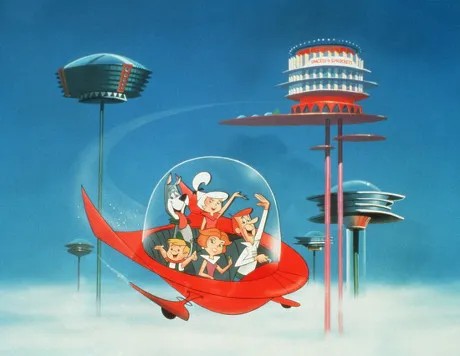
Living in a Sci-Fi Novel
By Ray Tabler
Philip Jose Farmer’s 1967 novella Riders of the Purple Wage starts off “…If Jules Verne could really have looked into the future, say 1966 A.D., he would have crapped in his pants…” Decorum aside, this sentiment captures a fundamental truth about the speed of technological and societal change. Verne grew up in a world lit by fire and moving at the pace of a horse. Before he passed away, coal-burning steam trains had become common. They were the bullet trains of the day. Verne was a futurist, gifted with words to paint the bright world of tomorrow. And yet, the reality of 1966 probably would’ve left him breathless.
From Verne’s point of view, the people of 1966 were truly living in a sci-fi novel. Many of his predictions had come true: aircraft, submarines, travel to the moon. And some curveballs would’ve floored him. From our point of view, 60 years down the road from 1966, that world looks quaint, cozy, and old-fashioned. Because, from where 1966 sits, we are currently living in a sci-fi novel. We’re just used to it.
Let’s take a look at the sci-fi elements all around us.
AI and robots – Okay, we probably don’t have for-real artificial intelligence, yet. However, it is getting harder and harder to tell the difference between true AI and the LLMs presently digging tunnels under the firewalls supposed to keep them contained. I won’t debate the sentience of these critters. But Jules Verne and even Philip Jose Farmer would’ve both raised eyebrows at the situation.
Industrial robots have been painting auto bodies and machining parts since at least the 1980s. They’ve been getting more versatile, more precise, and cheaper all that time. Relatively recently has someone stuck legs on those robots, allowing them to stand upright and move about. I’d say the AI/robot box is well on the way to being checked off.
Flying cars – Flying cars are way behind schedule, so to speak. If we, as a civilization, really wanted to convert the family sedan to the family helicopter we could’ve done it decades ago. The hold up is illustrated by Louis Armstrong’s famous quote about his fear of flying. “Say you in a car or a boat, and the motor quits. Well, there you is. Say you in an airplane, and the motor quits. Well, there you ain’t.” Although automobile fatalities are decreasing each year, they are still considerable. Adding the vertical dimension to traffic problem will inevitably complicate matters. I blame the insurance companies. Maybe AI piloting and traffic control will solve that issue. Until then, flying family cars will remain an alluring dream. Sigh.
Space stations and moonbases – Well, we do have a space station. It’s not very big, and approaching the end of its warranty. But everything humans build wears out, sooner or later. The pertinent question is whether we will build another one. And hopefully many more after that. I think we will, probably. SpaceX and Blue Origin are hard at work chopping the cost to orbit down to a size which makes a profit.
Likewise, it looks very much like the human race will establish a permanent presence on the moon. Mars colonies too, if we keep our fingers crossed. That’s good news after a 50-year hiatus. Like many endeavors, humanity knew how to do this for a while. We just lacked motivation. In the 1960s the driving force for manned moon missions, in both the US and the Soviet Union, was getting there first. Which only served until one side got there first. Then interest waned. Fortunately, greed has come to humanity’s rescue once again. It took a while, but now we realize there’s money to be made in space, and on the moon. Or so the smart money believes. And they’re likely right about that. Some will get rich. Some will lose their shirts. But we’ll all probably benefit in the long run.
Star ships – We are currently capable of sending a probe to another star. In fact, we already have. The Voyager probes officially left the solar system 6 and 7 years ago, the fastest objects ever built by man. So, check!
Of course, nobody’s aboard either of them. And it’ll take 40,000 tears for then to reach another star. Voyager 1 will pass close (1.6 light years) to Gliese 445, and Voyager 2 within interstellar shouting distance (1.7 light years) of Ross 248. They would’ve hit the nearest star system, Alpha Centauri, a lot sooner. But neither one’s headed that way. And, both probes will be out of power, lifeless lumps of hardware, long before then. But technically, man has entered the interstellar age.
More seriously, most people define star ships as having people aboard. We just don’t know how to keep those people alive long enough to make the trip worthwhile. We’re working on it. Suspended animation, extreme longevity, sustainable enclosed ecosystems for generation ships, and uploading consciousness to computers are all potential solutions to slower-than-light interstellar travel. No breakthroughs yet, but the mere fact we’re seriously researching these avenues qualifies as sci-fi come true from a 1966 perspective.
And a faster-than-light method of travel is now at least theoretically possible. The Alcubierre warp bubble concept is an honest-to-God Star Trek style warp drive, a loophole around Einstein’s relativistic speed limit. No one has a handle on how to reduce that to practice, yet. But NASA is working on that tech too.
Aliens – Hoo boy! Are there aliens about? Somewhere in the universe? Almost certainly. Around here? Maybe. Aliens are the modern equivalent of Prester John. Medieval legends told of a powerful Christian land isolated from Europe on the far side of the Islamic world, ruled over by a wise king, Prester John. Sooner or later, Prester John would lead his armies to put a squeeze play on the Muslims, liberating the holy land and reuniting Christendom.
We know now that Prester John didn’t exist. He was just wishful thinking, based on travelers’ rumors of Christians sects in India and Ethiopia, and even misunderstandings of the true nature of the Mongol Empire. When knowledge is lacking, imagination can spin fabulous tales. Today we face a profound lack of knowledge about aliens.
And yet, there remains a body of evidence which cannot be explained. Some UFOs (now rebranded as UAP, unidentified aerial phenomena) are “real.” The US government has recently released a flood of documented sightings, after decades of denial and coverup. Are they little green men? Time travelers? Visitors from alternate dimensions or the hollow Earth? I have no idea. And I am skeptical of people who claim to have the definitive answer. Prester John had some basis in misunderstood facts. But he was never riding to the rescue of the holy land. Aliens might very well be in the neighborhood. But we’re kidding ourselves to spin tales explaining their backgrounds and agenda. That would be science fiction. Until it isn’t. 😉
Utopia/dystopia – Utopias and dystopias are established genres of science fiction. Are there utopias or dystopias existing today? Depends.
The main difference between living in a utopia and living in a dystopia is where you sit in the pecking order. North Korea is a great place for high-ranking government officials. Not so much for the average North Korean. Of course, people who lean socialist might say the same thing about the USA. Undeserved opulence for the rich and grinding wage slavery for the masses. The real world is complicated. Novels, even sci-fi novels have to simplify to fit between 2 covers in an entertaining narrative. Nuance suffers. Societies, institutions, and groups of people tend to get sorted into good guys or bad guys because the story needs to move along.
Utopia/dystopia stories are almost always pushing a political or philosophical agenda of some kind. Any society can be cast as perfect or perfectly horrible by simply overemphasizing the good or the bad each real-world culture will possess. So, yes, we do have utopias and dystopias these days. Often, they are the exact same places.
Consider E. M. Forster’s 1909 short story The Machine Stops. In this future people live in isolation from each other, communicating only via video phone, totally reliant upon a global machine. Sound familiar? The title of the story lets the cat out of the bag. The machine stops. Civilization collapses. Frankly, many aspects of the modern world fit that description. Except our machine hasn’t stopped. Not yet.
Longevity and biotech – Human lifespans are on a steady upward trend. Will they plateau? If they do, can we improve upon that? Should we? In 1966, that type of question seemed safely academic. Today, we’d best start figuring out some answers. Because the reality is most likely coming soon.
We can already detect medical problems before birth. That capability precipitates an abortion choice. Fetal sex testing results have tilted the demographics in cultures which favor male children over female. That could have been predicted. But no one did.
The world just weathered a global pandemic. Depending on who you believe, that was the result of a bioweapon leaked from a lab. Bioweapon or not, 2020 was something right out of a novel.
The answer is, yes. We are living in a sci-fi novel. In truth, we always have been. The world isn’t changing, just what we know about it. The pace of our growing knowledge has, for the past few centuries, been constantly accelerating. Science fiction is simply an attempt to figure out the impact of those changes before they get here. Sometimes science fiction authors guess right, and we break our arms patting ourselves on the back. Other times we’re so far off it’s embarrassing. Either way, the technical or scientific advance is never the tough part. That’s just the trigger for our reaction. Science fiction’s utility lies in preparing our monkey brains for when fiction becomes reality.
END.
Shameless Self-Promotion Section:
Check out my published novels at:
nazcapress.com/product/smitty/NP/52/ (Smitty’s Guide to Interstellar Bartending, available for preorder now!)
https://histriabooks.com/product-tag/ray-tabler
amazon.com/stores/Ray-Tabler/author/B09H62RZB9
And visit my website https://raytabler.com/ for Science Fiction You Can Enjoy!